

BEYOND THE PROMPT
Why Generative AI Is Raising the Stakes for Human Judgment


For the past two years, we have been asking the question: “How do I write better prompts?” When generative AI burst onto the scene, those who learned to orchestrate its inputs gained an immediate advantage. Better prompts led to better outputs, and faster outputs created competitive leverage.
But every technological advantage eventually undergoes a quiet transformation, dissolving into the background of daily life. Electricity did. The internet did. Cloud computing did. Artificial intelligence is rapidly following the same path.
Knowing how to construct a functional AI prompt will soon be baseline literacy, not a durable distinction. When a tool becomes ubiquitous, operational capability stops being the frontier. That is where the real transition begins.
The Commoditization of Cognitive Outsourcing
For a brief, heady window, outsourcing parts of our intellectual labor produced what felt like exponential gains. Summaries replaced reading, AI-generated drafts replaced the hard labor of writing from first principles, and neat, synthetic answers replaced the messy process of exploration.
This shortcut economy worked exceptionally well—until everyone else started doing it too. The competitive advantage of basic AI integration is rapidly narrowing. When everyone has access to an infinite drafting machine, the draft itself becomes less scarce—and therefore less valuable. The bottleneck is no longer how quickly we generate answers, but how well we verify, contextualize and apply them.
We are witnessing a shift in what AI literacy means. Early definitions focused heavily on functional operation: the mechanics of the prompt. Today, functional competency must expand into critical AI literacy and evaluative judgment (Bearman et al. 893). Because generative systems can produce highly competent, professional-sounding prose almost instantly, humans must become not only creators of content, but more demanding interpreters, editors and arbiters of quality.
If we allow the machine to replace rather than support our thinking, we weaken the very faculties required to decide whether its outputs are correct, ethical, relevant or useful.
Edgar Morin and the Crisis of Simplified Knowledge
This tension is not entirely new. It is a digital amplification of a classic educational dilemma. Long before large language models were trained on global data, French philosopher and sociologist Edgar Morin warned that modern education tends to partition, isolate and fragment knowledge. By dividing complex realities into hyper-specialized disciplines, education can produce simplified answers to problems that are inherently interconnected and multidimensional (15).
Generative AI does not invalidate Morin’s warning; it amplifies it. Large language models are designed to produce coherent, authoritative-sounding responses. They reduce friction by offering smooth syntheses. When we ask AI to summarize a socioeconomic debate or resolve a multilayered design problem, it moves quickly toward a polished answer.
If we accept those frictionless summaries uncritically, we risk mistaking grammatical confidence for understanding. As machines become better at producing convincing answers, humans assume a heavier responsibility: to ask questions that can hold complexity without rushing toward simplified certainty.
The New Competitive Edge: Intellectual Discomfort
Prompt engineering still has practical value, but it no longer defines the competitive frontier. The modern edge belongs to judgment.
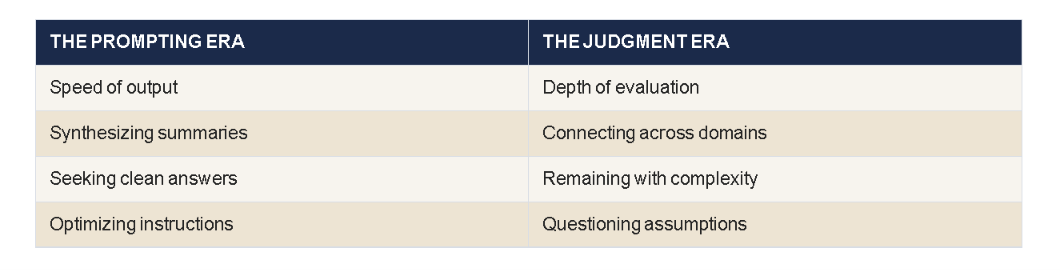
This transition demands three cognitive shifts:
The willingness to remain intellectually uncomfortable. The first and most convenient answer offered by a machine is not necessarily the most insightful one.
Cross-domain synthesis. Human experience, association and contextual judgment contribute forms of connection that statistical prediction alone cannot supply.
Rigorous metacognition. We must continually examine how we know what we know, guarding against automation bias and epistemic overtrust.
This is not a nostalgic plea to abandon technology. It is an act of cognitive self-preservation. Perhaps this is the real paradox of our moment: we spent years fearing that artificial intelligence would replace human thinking. Instead, it is increasing the premium on those who refuse to stop doing it.
AI is not making complex thinking obsolete. It is making simplistic thinking obsolete.
Works Cited
Bearman, Margaret, et al. “Developing Evaluative Judgement for a Time of Generative Artificial Intelligence.” Assessment & Evaluation in Higher Education, vol. 49, no. 6, 2024, pp. 893–905. Taylor & Francis Online, https://doi.org/10.1080/02602938.2024.2335321.
Morin, Edgar. Seven Complex Lessons in Education for the Future. UNESCO, 2001.
Content Authenticity Statement
This piece developed through an extended dialogue with AI. The retrieval, the scaffolding, the drafts — those are the machine’s contribution. The intellectual architecture, the named gaps, and the synthesis are mine. The human remains the constitutional authority.